
Reviewed · WALKING TOURS IN SARAJEVO
Sarajevo Essential Full Walking Tour
Sarajevo hits you fast. In just 1 to 2 hours, this walking tour threads together the city’s Catholic, Ottoman, Orthodox, and Austro-Hungarian layers in one practical route. You get big landmarks and small details without needing to plan like a historian.
What I like most is the tight focus on the city’s “meeting points.” You’ll see places like the Gazi Husrev-beg Mosque and the Sarajevo City Hall (Vijećnica), then you’ll be told what each one meant in its moment. Also, the route squeezes in craft and everyday Sarajevo energy, including coppersmithing on Kazandziluk and the Ottoman Sebilj fountain.
One thing to consider: this is a fast sampler. Most stops are brief, and a couple of sights list admission tickets as not included, so you might pay extra if you want to go inside.
Key things that make this tour worth your time

- Small-group pacing: capped at 50 people, and the schedule is built from short stops that keep moving.
- Religion plus everyday life: you pass Catholic, Muslim, Orthodox, and Jewish sites and also hit markets and craft streets.
- A guide can make or break it: guides like Adnan (Ado) are praised for being easy to listen to and for handling lots of questions.
- Ottoman Sarajevo highlights: you get the mosque, the covered bazaar (Bezistan), and the waqf complex at Taslihan.
- War memory included without getting heavy: Latin Bridge and the Sarajevo Rose are part of the walk, not a separate detour.
How a 1 to 2 hour Sarajevo walk can save you time
Sarajevo is one of those cities where every street seems to have a second story. The trick is not trying to see everything alone, then ending up with random photos and no connections.
This tour is designed to give you a clean framework. You start with Sarajevo’s Catholic centerpiece, then work your way through the Ottoman core, the old bazaar world, and the Austro-Hungarian landmarks. By the time you reach the Latin Bridge area and the Sarajevo Rose memorial, you understand why Sarajevo’s mix of faiths and empires matters.
The timing is also realistic. The stops average around 5 to 10 minutes each, so you are not stuck in a long museum line or waiting at one building for ages. If you only have a morning or an afternoon to get oriented, that matters.
More Walking Tours in Sarajevo
- Sarajevo: Grand Walking Tour Through Time and Cultures
★ 4.8 · 1,236 reviews - Sarajevo: 2 Hours Old Town Walking Tour With Local Guide
★ 5.0 · 505 reviews - Private Walking Tour, Food Tasting and Bosnian Coffee in Sarajevo
★ 5.0 · 255 reviews
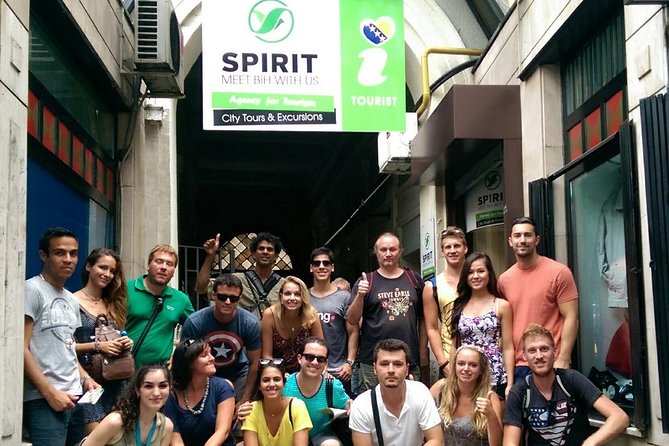
Starting at Spirit Tours on Ferhadija Street
The meeting point is Spirit Tours Ferhadija 19, Sarajevo 71000. The tour ends back at the same place, so you are not stranded across town wondering how to get home.
Pickup is offered if you arrange it in advance. That can be a lifesaver if you are staying a bit outside the Old Town core. The tour also notes it is near public transportation, which is useful if you are bouncing between Sarajevo sights by tram or walking.
One more practical point: you receive a mobile ticket, and the tour runs in English. If your group includes different comfort levels, a short guided loop like this helps everyone keep the same pace.
The route: Cathedral to Vijećnica, where empires leave buildings behind
The opening stop is the Cathedral of Jesus’ Sacred Heart, built in 1889 in a Neo-Gothic style. This is the biggest Catholic church in Sarajevo and the seat of the Archdiocese of Vrhbosna. It sets the tone right away: Sarajevo is not one culture frozen in time, it is layers piled on top of layers.
Next comes the Museum of the Jews of Bosnia and Herzegovina. It sits within the City Museum of Sarajevo and is in the oldest synagogue in Bosnia and Herzegovina. The ticket is not included, so you should decide if you want to pay the museum entry when you arrive. If you do, it adds real depth to the rest of the route, because you will start noticing how the city’s identities overlap rather than exist in separate boxes.
After that, you head to the spot marked Sarajevo Meeting of Cultures on Ferhadija St., near Gazi Husrev Bey’s Bezistan. This is not a museum stop. It is a signpost moment, the kind that helps you read the city as a set of relationships, not just a list of buildings.
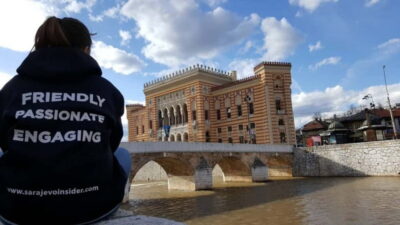
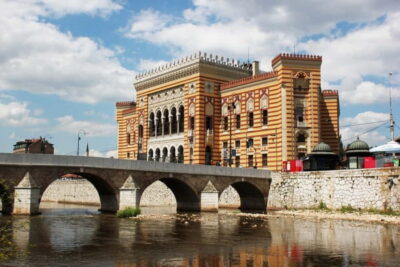
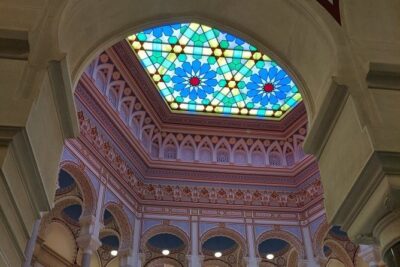
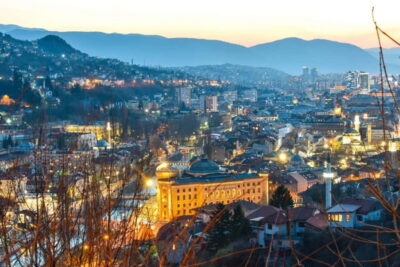
Then you land at Sarajevo City Hall, Vijećnica. This is one of the most extravagant structures from the Austro-Hungarian occupation era, and it is treated as a symbol of the meeting of world civilizations. The admission ticket is not included here, so you can either admire it from the outside or decide later if you want to pay for an interior visit.
This section of the walk is also where the route gives you contrasts. Sacred Heart Cathedral and Vijećnica are both big, but they feel different in purpose and design. That contrast is a useful mental anchor when you later see the older Ottoman structures.
Ottoman Sarajevo in short stops: Mosque, Sebilj, Bezistan, Taslihan
The Ottoman core shows up early, with the Gazi Husrev-beg Mosque. Built in the 16th century, it is described as the largest historical mosque in Bosnia and Herzegovina and one of the most representative Ottoman structures in the Balkans. Even if you only have a few minutes, this is the kind of building you should look at slowly at least once, because the details are part of why it matters.
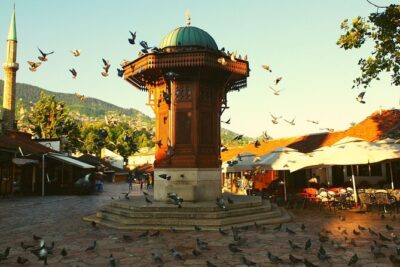
From there, you pause at Sebilj Brunnen in Baščaršija Square. The Sebilj is an Ottoman-style wooden fountain built by Mehmed Pasha Kukavica in 1753. It is short and sweet, about 5 minutes, but it is a great moment to stand still and watch how the square works. Think of it as your reset button between major monuments.
Then comes Kazandziluk, the coppersmith street. This is where the tour shifts from architecture to craft. The coppersmith craft still lives here, and the street has kept its authentic look for centuries. This is the stop I’d prioritize if you enjoy seeing how people actually make things, not just where people once lived. It is also the most “everyday” feeling part of the walk.
You also get Gazi-Husrev Beg’s Bezistan, a covered bazaar from the Ottoman period built in 1555. It still serves trade, so you are not looking at an empty shell turned into a souvenir shop. It is a living commercial space, which changes the whole mood of the visit.
Taslihan is the next waqf complex, built in 1543. It had a fountain, mosque, yard, shops, and storage rooms, and it was damaged in multiple fires. This is another stop that helps you understand that Ottoman Sarajevo was not only about big religious buildings, it was also about infrastructure for trade and community functions.
One small drawback to keep in mind: many of these Ottoman sites are big and detailed, but your time at each is short. If you love architecture, you will likely want to come back later on your own and spend extra time.
More around Sarajevo to weigh up
- Sarajevo Grand Walking Tour
★ 5.0 · 232 reviews - Sarajevo: Old Town Walking Tour with Local Guide
★ 4.9 · 211 reviews - Sarajevo: Discover Sarajevo Walking Tour with Local Guide
★ 4.9 · 92 reviews - Discover Sarajevo Walking Tour with Local Guide
★ 5.0 · 75 reviews
Bridges, war memory, and the Spite House story
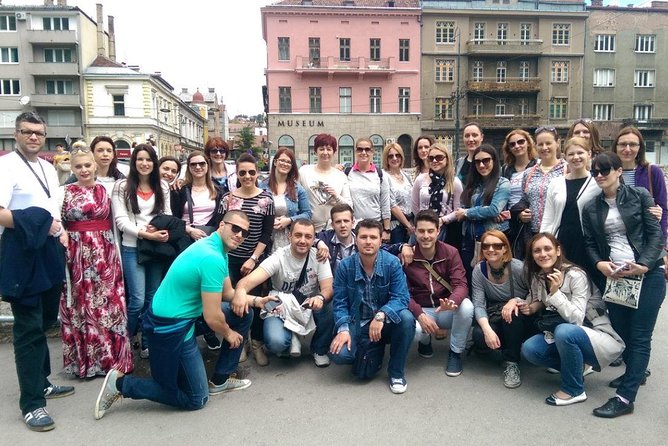
The route includes Cumurija Bridge, with the Spite House nearby. The story goes that the owner did not want to sell, so the house became known as the Spite House. Today it functions as a protected cultural and historical heritage site and is a popular national restaurant.
Even if you do not stop for food, this is a good moment to notice how Sarajevo’s daily life and its historical quirks sit right next to each other. The bridge is functional, but the legend makes it memorable.
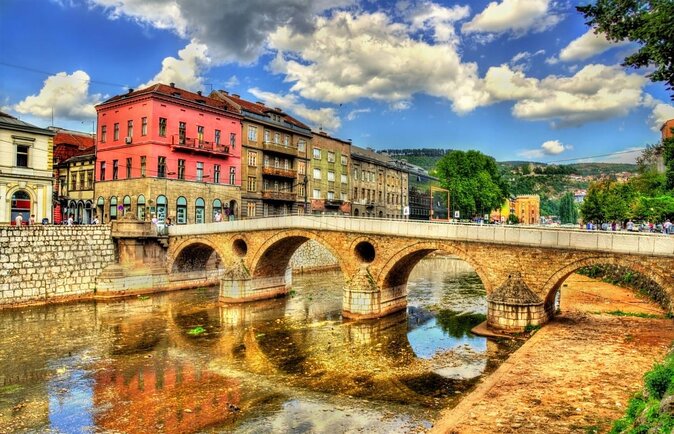
Then you reach Latin Bridge, also known as Principov Most. This is where Gavrilo Princip assassinated Archduke Franz Ferdinand and his wife, Sofie, and that assassination is tied directly to the start of World War I. This stop is about place and consequence. You are standing at a point in history that changed Europe, and the guide’s job is to connect the event to what Sarajevo had become by then.
Close to this area in the walk is Sarajevo Rose. This is a memorial made from concrete scar from a mortar shell explosion, later filled with red resin. It is a quiet, physical reminder that the city’s 20th-century trauma is not abstract.
If you prefer your history in big museums, this portion might feel emotional. But it is also brief and guided, which keeps it from turning into a heavy detour.
The city’s religious triangle: Emperor’s Mosque, Orthodox church, and the multiethnic monument
After the Latin Bridge story, the tour brings you back into the theme of shared space. The Emperor’s Mosque is Sarajevo’s oldest mosque and one of the oldest in Bosnia and Herzegovina. It is presumed that Isa Bey Ishaković, the founder of Sarajevo, built it soon after the city’s founding in 1462, in honor of Sultan Mehmed II.
Then you reach Centar, the Cathedral Church of the Nativity of the Theotokos. This is the largest Serbian Orthodox church in Sarajevo and one of the largest in the Balkans. It is another big identity marker, but by the time you see it you have already seen how the city distributes its major faiths across central streets.
Between the Catholic, Muslim, and Orthodox landmarks is the Monument All Man Multicultural, described as the multiethnic human. The monument is positioned in the center between three major religious symbols, with text carved in Italian and Bosnian, tying the theme to the idea of building the world.
This cluster is one of the reasons the walking format works. You do not just see monuments in isolation. You see how they are literally near each other, how Sarajevo teaches you that coexistence can be both a design and a struggle.
A quick Austro-Hungarian reminder: Europe Hotel in the Old Town core
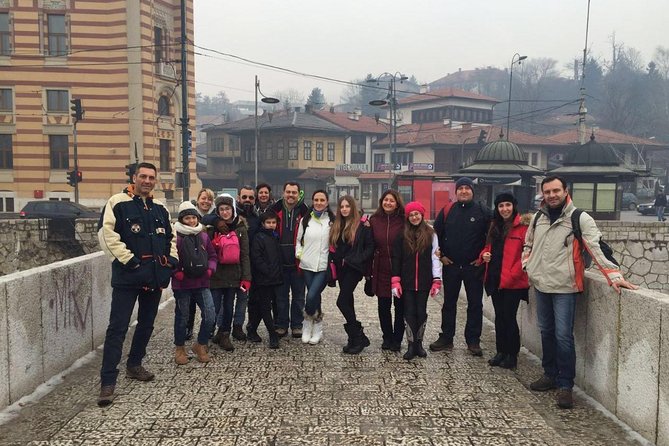
The route also includes a stop at Europe Hotel. It is positioned in the heart of Sarajevo, just a few steps away from the tourist Old Town core, and it is described as an Austro-Hungarian building with external splendour that grabs your attention right away.
It is a short stop, about 5 minutes, and no admission is needed. But it acts like a visual palate cleanser. After Ottoman textures and war memory, you get a reminder that Sarajevo also lived under older imperial architecture and European-style city design.
Price and what you truly get from $18.15
At $18.15 per person, this tour is priced like an efficient orientation. The included items are a local guide and professional guide, with a mobile ticket. Food and drinks are not included, which is normal for this kind of short walking route.
Value here comes from the density of sights. In one loop you cover 16 named stops, including big-ticket architecture like the mosque and City Hall, plus smaller, high-information stops like Kazandziluk and Bezistan.
Two stops list admission tickets as not included: the Museum of the Jews of Bosnia and Herzegovina and Sarajevo City Hall (Vijećnica). That matters because if you are the type who always pays for an interior, you may want to budget a bit extra. If you are happy with exterior viewing, the tour still functions as a strong overview.
What you should not expect is museum-style time. This is a walking highlights tour. It gives context and insider direction, then sends you off to explore further if you want.
When a small group matters, and why guide quality shows
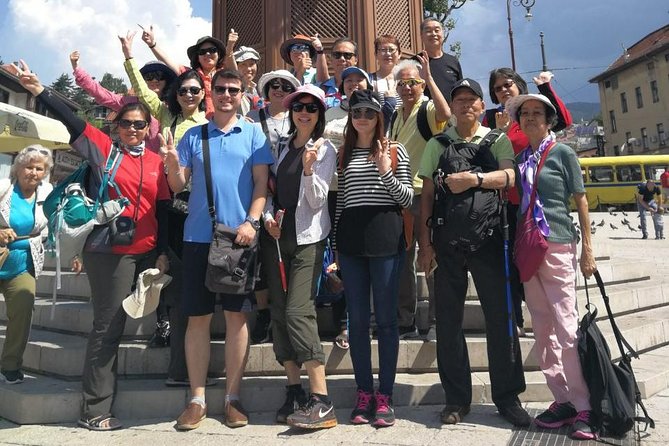
Group size is capped at 50 travelers, and the tour is typically booked about 8 days in advance. That means it often feels organized, not chaotic. Also, the route includes a lot of places that people can miss if they wander alone, especially the craft street feel of Kazandziluk and the way Ottoman bazaar structures are preserved.
The best part is the guide. One standout detail from guide feedback is that Adnan (Ado) is praised for being easy to listen to, educated, and authoritative. There is also a note that when the group was very small, he handled lots of questions easily.
So if you care about asking follow-ups, this format can actually work better than a giant bus tour. You get enough structure to understand what you are seeing, but you can still steer the conversation.
Practical tips so you get the most from the walk
A few choices will help this tour land well for you.
First, wear comfortable walking shoes. With 1 to 2 hours of movement and multiple short stops, you will be on your feet more than you think. Second, take your time at the big visual anchors, like the Gazi Husrev-beg Mosque, Vijećnica, and Latin Bridge. You only get a short stop, so use the moment to look at details, not just snap photos.
Third, if you know you want interior access, plan ahead for the two not-included admission stops. You can decide on the spot, but it helps to be mentally ready to pay if you want to go in.
Finally, bring water or plan to buy it nearby. Food and drinks are not included, and the stops are short enough that you may not have much time for a long break.
Should you book it? My quick decision guide
Book this tour if:
- You want a fast orientation that still touches the deeper stories behind Sarajevo.
- You like seeing how different cultures and empires show up on the same streets.
- You enjoy craft and everyday city life, especially the coppersmith street and bazaar stops.
- You want a guide who can handle questions, with examples like Adnan (Ado) doing that well in small groups.
Skip it or do something else first if:
- You need long museum time, with lots of interior viewing.
- You want a full day focused on one theme, like Ottoman architecture only or World War I only.
If your goal is to get your bearings fast and leave with clear connections between buildings, the $18.15 price feels fair. It is a compact way to understand why Sarajevo looks the way it does.
FAQ
How long is the Sarajevo Essential Full Walking Tour?
It runs for about 1 to 2 hours.
What is the meeting point for the tour?
The tour starts at Spirit Tours, Ferhadija 19, Sarajevo 71000, Bosnia and Herzegovina, and it ends back at the same meeting point.
Is pickup available?
Pickup is offered. If you need pickup, you can arrange it in advance for a hotel, apartment, or hostel.
What language is the tour offered in?
The tour is offered in English.
Is the price fully inclusive of admission tickets?
Not fully. The Museum of the Jews of Bosnia and Herzegovina and Sarajevo City Hall list admission tickets as not included.
What is the cancellation policy window?
You can cancel up to 24 hours in advance for a full refund. If you cancel less than 24 hours before the start time, the amount paid is not refunded.
Newest Sarajevo write-ups
- Sarajevo to Zagreb: One-Way Tour via Jajce, Travnik, Pliva Lake and Watermills★ 5.0 · 3 reviews
- Mountain Village Lukomir Full Day Adventure Tour★ 5.0 · 3 reviews
- Sarajevo E-Bike City Tour★ 5.0 · 3 reviews
- Bosnian Kingdom Capitals: Travnik & Jajce Tour from Sarajevo★ 5.0 · 3 reviews
- Strbacki Buk and Una Waterfalls: Day Trip from Sarajevo★ 5.0 · 3 reviews
- Sarajevo Snowshoeing Adventure★ 5.0 · 3 reviews
- Sarajevo Old Town: Bosnian Coffee, Baklava & Panoramic Views★ 5.0 · 3 reviews
- 4 Hours Tara Rafting Trip★ 5.0 · 3 reviews
Walking Tours in Sarajevo, compared.
Private Walking Tour, Food Tasting and Bosnian Coffee in Sarajevo
Read our review →
Browse the lists this tour appears in