
Reviewed · WALKING TOURS IN SARAJEVO
InstaSarajevo – Photography Walking Tour of Sarajevo
Sarajevo is a city built for photos, and this walking tour is the practical way to turn those streets into social-ready pictures. I love that you get a certified photographer guiding your shots and I love how the route hits iconic corners that actually tell stories as you walk.
There is a small catch: you are out walking for about 2 to 3 hours and you’ll want decent weather. If rain or strong wind hits, your plan can change, and you might not get every photo moment you hoped for. When I took the tour with Kenan from Adventure in Bosnia, the focus stayed tight and friendly, so you still felt productive even when light was tricky.
Key highlights you should know
- Professional photo coaching in a small group (max 4), so you are not just following along
- Sebilj Brunnen and Pigeon Square as a classic Sarajevo photo opener
- Old town stops you can shoot from multiple angles, from bazaars to bridges
- Austro-Hungarian and Ottoman contrasts in close walking distance
- Free access to the listed stops, so you are not juggling paid tickets
- English-speaking guide and mobile ticket for an easy start
A Photo Walk That Teaches You Where to Stand in Sarajevo
Sarajevo has a talent for mixing time periods in the same frame. One minute you are looking at Ottoman-era detail, the next you are staring at Austro-Hungarian architecture, and then you are right at the Latin Bridge area where modern history changed course. This tour leans into that mix, and it gives you the photographer’s habit of asking one simple question: what is the best angle right here?
What makes it work for most people is the pacing. This is not a museum crawl where you stand and listen for too long. You move, you stop, and you shoot. The guide is also a professional photographer, so you get direction that fits the actual street scene, not generic camera advice. For anyone traveling solo, this part is gold, because it helps you leave with photos that look like you had a plan, even if you were just winging it when you arrived.
The best value is that you get the photos plus context. You learn what you are looking at, so your pictures stop being random postcards and start having meaning.
More Walking Tours in Sarajevo
- Sarajevo: Grand Walking Tour Through Time and Cultures
★ 4.8 · 1,236 reviews - Sarajevo: 2 Hours Old Town Walking Tour With Local Guide
★ 5.0 · 505 reviews - Private Walking Tour, Food Tasting and Bosnian Coffee in Sarajevo
★ 5.0 · 255 reviews
Price and timing: what you’re really paying for
The price is $34.92 per person, and the duration is about 2 to 3 hours. That is a fair ask for two reasons.
First, the tour includes a certified guide who is also a professional photographer. You are paying for expertise, not just walking directions.
Second, the route is set up to use your time efficiently. Many stops are free to access, so you spend the money on guidance rather than entrances. You also start and end at the same place, so you are not trying to coordinate with the rest of the city while you are thinking about your next shot.
One more practical note: the tour is booked about 5 days in advance on average, so if you want a specific day, plan a little ahead.
Your starting point: Kovači 25 and a focused 10:00 am start
You meet at Kovači 25, Sarajevo, and the tour starts at 10:00 am. It ends back at the meeting point. That might sound basic, but it matters because Sarajevo’s old town is compact, and you do not want to burn time figuring out where your route begins or ends.
The tour is offered in English, which helps a lot if you want to understand the why behind what you see. The group cap is small, up to 4 travelers, so you get more of the photographer attention. It is also listed as suitable for most travelers, and service animals are allowed. And yes, it is near public transportation, which makes it easier to link with the rest of your day.
Stop 1: Sebilj Brunnen, the fountain that anchors the whole photo loop
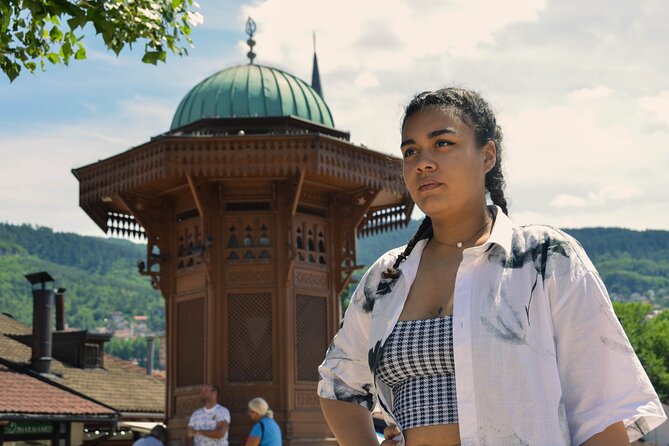
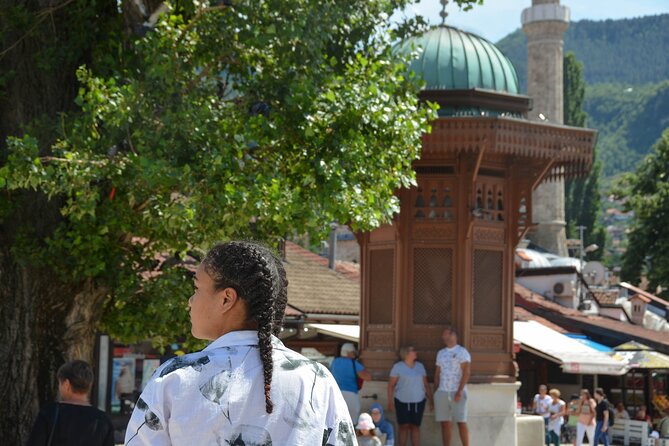
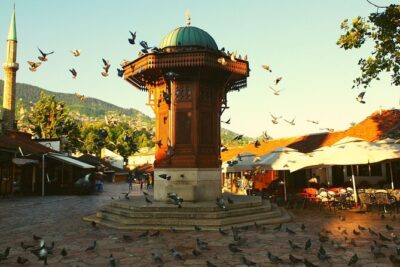
The tour begins at Sebilj Brunnen, the fountain on Baščaršija Square. Sarajevo used to have hundreds of sebiljs, kiosk-shaped public fountains, but today this one is the last. It is a major city symbol, and it is the kind of place where the details do the work for you.
This is also where you get the fun connection called Pigeon Square, which is an amazing photo spot. The open space gives you options fast. You can frame the fountain with the square around it, or you can shoot closer and let the structure dominate your composition.
What I like about using Sebilj as a starting point is that it is instantly recognizable. Your photos start strong, and you ease into the idea that you will be shooting street scenes, not just monuments.
More around Sarajevo to weigh up
- Sarajevo Grand Walking Tour
★ 5.0 · 232 reviews - Sarajevo: Old Town Walking Tour with Local Guide
★ 4.9 · 211 reviews - Sarajevo Essential Full Walking Tour
★ 5.0 · 198 reviews - Sarajevo: Discover Sarajevo Walking Tour with Local Guide
★ 4.9 · 92 reviews
Stop 2: Baščaršija and Kazandžiluk, old craft streets with real texture
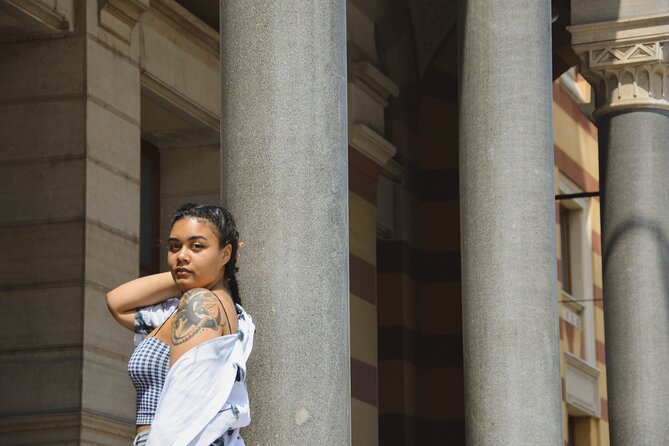
From Baščaršija Square you move into the older lanes, where Kazandžiluk is one of the oldest and most recognizable streets. It used to be part of a larger area called Kazandžijska Čaršija, which included nearby streets like Luledžina and Oprkanj.
Kazandžiluk takes its name from kazandžijas, master metalworkers and coppersmiths. They started by producing kettles for the army, then shifted toward copper vessels used in everyday life, like ewers, pitchers, coffee pots, metal table tops, and trays. At the height of Ottoman Sarajevo’s Golden Age, they produced around a hundred different kinds of items.
Even if you never buy anything, these streets photograph well because of the surfaces and the layout. You get close-up angles, signs of craft, and the feeling that the city still has work happening inside it.
Possible drawback here: if you have mobility limits, the old streets can involve uneven paving. The tour is short overall, but you may want comfortable shoes.
Stop 3: Sarajevo City Hall and Neo-Moorish details in Austro-Hungarian Sarajevo
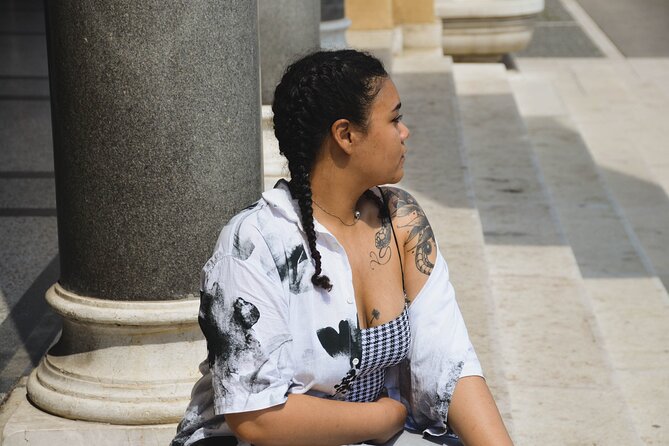
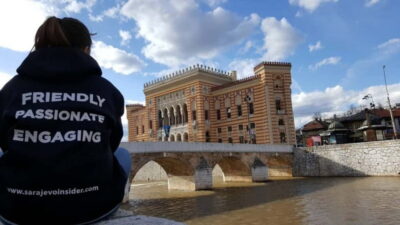
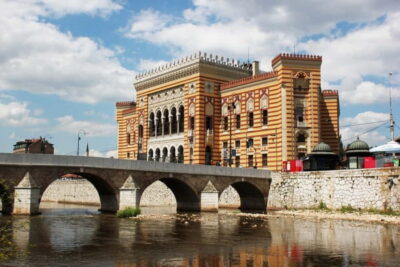
Next comes Sarajevo City Hall, completed in 1896. This building represents the Austro-Hungarian period, and it is also known for a Neo-Moorish style inspired by Islamic art in Spain and North Africa.
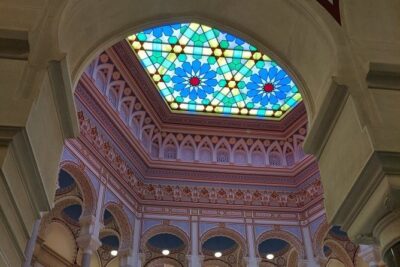
If you care about architecture, this stop is a gift. You can compare it visually to the Ottoman elements you saw earlier, without needing to jump across town. For photography, buildings like this help because the lines and ornamentation let you shoot both wide frames and detail shots.
A practical tip in the spirit of the tour: don’t just photograph the front. Try a side angle to capture how the building sits in the street around it.
Stop 4: Latin Bridge, where the story is bigger than the frame
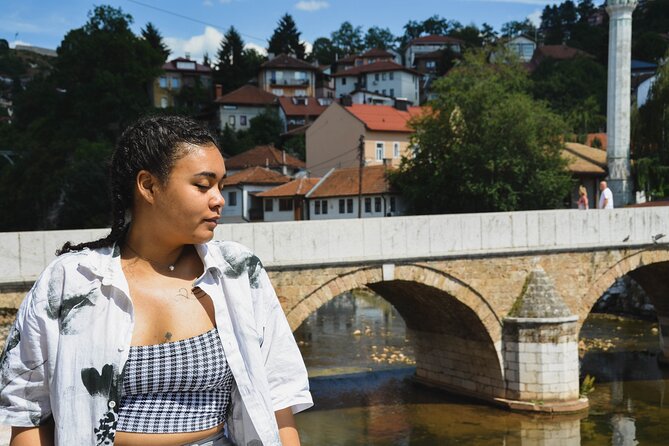
Right next to Latin Bridge, you learn about the assassination of Archduke Franz Ferdinand and Sophie. The reason this stop matters for a photo walk is that it turns a landmark into a timeline. You are photographing a place connected to a world-changing event, not just a pretty bridge.
For pictures, bridges can be both easy and tricky. Easy because you get leading lines and symmetry. Tricky because crowds and traffic can steal your clean shot. The small-group format helps, because the guide can time your moments with the reality of the square.
You also get a good mental reset here. Earlier stops were about craft, fountains, and architecture. This one is about context, and that makes your next photos land differently.
Stop 5: Gazi-Husrev Beg’s Bezistan, a covered bazaar built for stopping and looking up
Gazi-Husrev Beg’s Bezistan is a covered bazaar, also called Old Bezistan or Great Bezistan. It is part of the Gazi Husrev Bey’s vakuf endowment, and the structure is presumed to have been built around 1540.
Covered bazaars are great for photography because the ceiling gives you natural frames. You also get a mix of light and shadow, which helps your photos feel less flat and more atmospheric.
What I like about including Bezistan on the route is that it shifts you from open squares into a more intimate space. Your camera eye changes. You stop thinking only about landmarks and start thinking about texture, repetition, and patterns.
Stop 6: Gazi Husrev-beg Mosque, the Ottoman centerpiece you can’t ignore
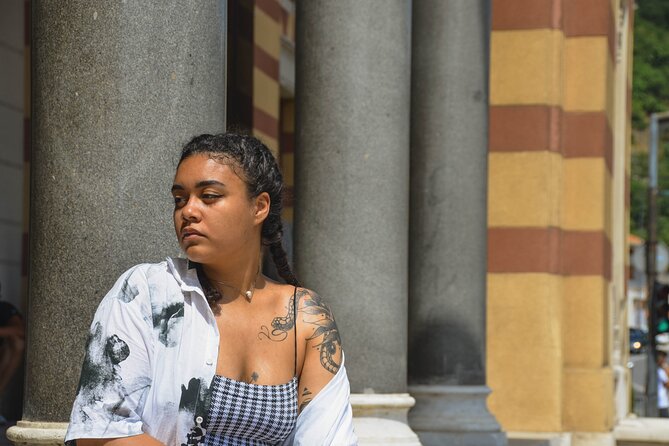
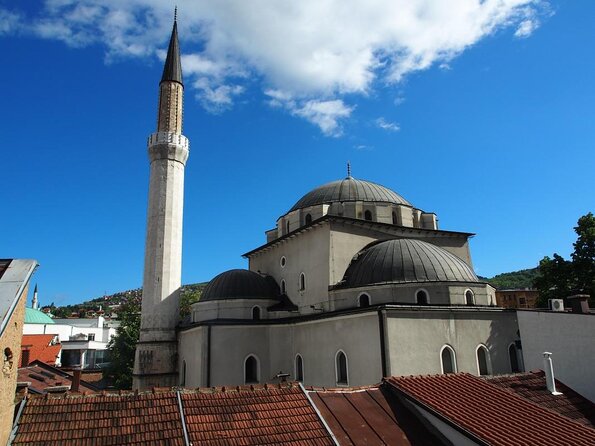
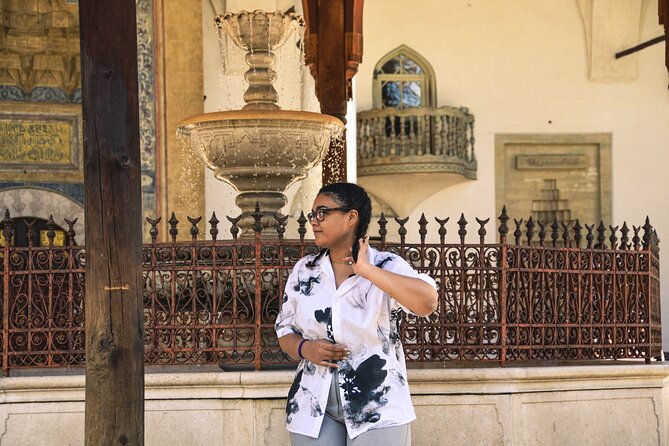
Then it’s Gazi Husrev-beg Mosque, built in the 16th century. It is listed as the largest historical mosque in Bosnia and Herzegovina and one of the most representative Ottoman structures in the Balkans. It was and still is central to Sarajevo’s mosque community, serving as the main congregational mosque in Bosnia and Herzegovina.
For photos, a major mosque is more than a shape. It is scale. It dominates the street scene, and it gives you a clear subject to anchor your frame. If you like architecture photos, this is the stop where your images start to look intentional and not random.
One detail to keep in mind: the tour notes that Gazi Husrev Bey’s Hamam (Turkish bath) fits in beautifully as a background element. That kind of “background planning” is exactly what a photographer guide brings to the walk.
Stop 7: Katedrala Srca Isusova, Sarajevo’s cathedral with European echoes
Next is Katedrala Srca Isusova (Sacred Heart Cathedral). The architect Josip Vancaš, Hungarian by origin, took inspiration from Notre Dame Cathedral in Dijon and St. Teyn Cathedral in Prague.
Here’s the interesting part: the cathedral ended up as an entirely new and authentic building that also fits with its surroundings. The tour highlights a nice visual pairing, with Gazi Husrev Bey’s Hamam in the background.
For your camera, this is a stop that rewards patience. You can shoot the cathedral as a standalone statement, but the more interesting approach is to include the surrounding Ottoman-era textures when you can. That helps your photos capture Sarajevo’s mix in a single frame.
Stop 8: Sarajevo Meeting of Cultures, the same spot, two totally different photographs
The final stop is called Sarajevo Meeting of Cultures. This is where East meets West, and the guide shows you a particular place to take two completely different photos from the same spot.
This is a clever way to end the tour because it turns the whole experience into a photo lesson. You stop thinking, where is the best monument, and you start thinking, what do I want my photo to say.
It is also a nice way to wrap up the day if you have any energy left and you want to continue shooting on your own right after. You leave with a mental model, not just images.
What you’ll get from a photographer-guided walk (not just sightseeing)
A regular walking tour can give you history and a route. This one adds a practical skill: learning how to frame street photography in real conditions.
In one review, the standout point was that the tour is an opportunity for solo travelers and nomads to get professional photographs they can share on social profiles, while also learning about street photography. That matches the tour style: you are not only looking at sights, you are learning how to photograph what’s in front of you.
If you bring a phone, you can still benefit. If you bring a camera, you’ll appreciate the same focus on angles and placement. Either way, the small group size means the guide can adjust how you shoot rather than rushing everyone through the same poses.
And yes, it is a history tour too. The stops are packed with details, from Ottoman artisans producing copper goods to Austro-Hungarian architectural inspiration to the Latin Bridge assassination story.
Who this suits best, and who should think twice
This tour is a strong fit if you:
- want great photos without spending the whole trip in front of a wall
- like architecture and street-level details
- travel solo and want help getting good shots when you do not have anyone to take them
- prefer a small group and a clear, guided pace
It might feel less ideal if you:
- dislike walking for 2 to 3 hours, even at a relaxed pace
- need guaranteed indoor time, since the experience requires good weather
- want a purely deep-dive history lecture instead of a photo-and-context approach
Should you book InstaSarajevo for Sarajevo?
If you care about photos and you want them to look like they belong to you, this is an easy yes. The value is in the combo of professional photographer guidance plus a route that makes sense for both learning and shooting. The fact that the stops are free to access keeps things practical.
Book it especially if you are arriving without a plan for where to stand and what to photograph first. Sarajevo can overwhelm you with corners and details. This tour gives you a short path through the best scenes, with enough instruction that you can keep shooting after the walk ends.
FAQ
How long is the InstaSarajevo Photography Walking Tour?
The tour lasts about 2 to 3 hours.
What language is the tour offered in?
The tour is offered in English.
What is the meeting point and start time?
You meet at Kovači 25, Sarajevo, and the start time is 10:00 am.
Is the tour free to enter at the stops?
All listed stops are marked as free, so you should not need to pay entrance tickets for the sights included in the route.
How many people are in a group?
The tour has a maximum of 4 travelers.
What happens if the weather is poor?
The experience requires good weather. If it is canceled due to poor weather, you will be offered a different date or a full refund.
More Photography Sessions in Sarajevo
- Sarajevo Private Photography Tour
★ 5.0 · 10 reviews
Newest Sarajevo write-ups
- Sarajevo to Zagreb: One-Way Tour via Jajce, Travnik, Pliva Lake and Watermills★ 5.0 · 3 reviews
- Sarajevo E-Bike City Tour★ 5.0 · 3 reviews
- Mountain Village Lukomir Full Day Adventure Tour★ 5.0 · 3 reviews
- Bosnian Kingdom Capitals: Travnik & Jajce Tour from Sarajevo★ 5.0 · 3 reviews
- Strbacki Buk and Una Waterfalls: Day Trip from Sarajevo★ 5.0 · 3 reviews
- Sarajevo Old Town: Bosnian Coffee, Baklava & Panoramic Views★ 5.0 · 3 reviews
- Sarajevo Snowshoeing Adventure★ 5.0 · 3 reviews
- PRIVATE Sarajevo Under Siege War Tour★ 5.0 · 3 reviews
Walking Tours in Sarajevo, compared.
Private Walking Tour, Food Tasting and Bosnian Coffee in Sarajevo
Read our review →
Browse the lists this tour appears in